Shared Stories, Shared Strength
Therapeutic Film Screenings as Interpretive, Relational, and Meaning-Making Practice in SIDS Bereavement
Shared Stories, Shared Strength is a research project funded by the SIDS Calgary Society exploring how facilitated screenings of peer-created digital stories may support bereaved families following the sudden death of an infant due to SIDS. Led by Dr. Mike Lang and Dr. Kate Wong in the University of Calgary Faculty of Nursing, the project explores if storytelling, dialogue, and shared reflection can create opportunities for connection, validation, and meaning-making in the midst of profound and persistent grief.
More About the Project
Principal Investigator:
Dr. Mike Lang, Faculty of Nursing, University of Calgary
Co-Investigator:
Dr. Kate Wong, Faculty of Nursing, University of Calgary
Research Coordinator:
Linda Day, RN
Digital Storytelling Facilitator:
Melody Williamson, MSc., B.A.
Psychologist Support:
Danielle Lemky, R.Psych.
Start Date:
June 2026
Expected End Date:
June 2027
Conceptual Framing and Rationale
Bereavement following the sudden death of an infant is often marked not only by profound grief, but by a disruption in language itself. Parents frequently describe an inability to articulate their experience within dominant social and clinical frameworks, resulting in isolation, fractured communication, and a diminished capacity for shared meaning-making. Empirical research on sudden infant death syndrome (SIDS)/sudden unexpected infant death syndrome (SUIDS) bereavement consistently demonstrates elevated levels of prolonged and complicated grief, persistent guilt, and enduring psychological distress, often extending well beyond the acute period of loss (Goldstein et al., 2018; Gandino et al., 2023). Parents, and particularly mothers, frequently report ongoing self-blame and unresolved questions surrounding cause and responsibility, even in the absence of medical explanation (Garstang et al., 2016). Within this context, the question is not simply how grief is expressed, but how it becomes sayable, shareable, and recognizable within relational spaces.
Digital storytelling (DST) has emerged within health research as a participatory, arts-based methodology that enables individuals to craft short, first-person multimedia narratives integrating voice, image, music, and video editing technique (Lambert, 2013; Lang et al., 2019). Across diverse contexts, DST has been shown to support processes of reflection, identity reconstruction, and relational connection (De Vecchi et al., 2016; Laing et al., 2017; West et al., 2022). Importantly, this body of work has largely focused on the process of story creation as therapeutic and epistemically generative.
However, a critical gap remains. While DST scholarship has robustly examined what occurs when individuals create stories, far less attention has been given to what occurs when stories are encountered. That is, how do individuals interpret, respond to, and integrate the stories of others within their own lived experience? This project addresses that gap by shifting the analytic and methodological focus from narrative production to narrative reception within facilitated, relational contexts.
This shift is not merely procedural; it is philosophical. Drawing on Gadamerian hermeneutics, understanding is not conceived as the extraction of meaning from a fixed object, but as an event that occurs in the encounter between interpreter and text, shaped by history, language, and culture (Gadamer, 1975/2004). In this view, a digital story is not a container of meaning. It is an invitation into interpretation. Meaning emerges not in the story alone, but in the dialogical space between story and listener.
The SIDS Calgary Society digital story archive, consisting of first-person narratives created by bereaved families, offers a uniquely powerful site for such encounters. These stories do not generalize grief; they particularize it. They render visible what is often unsaid or unsayable, allowing for forms of recognition that exceed informational exchange. As Charon (2006) suggested within narrative medicine, stories function as a means of “bearing witness” to suffering, enabling forms of understanding that are relational rather than purely cognitive. This is particularly significant in the context of SIDS bereavement, where parents frequently report that their experiences are misunderstood, minimized, or avoided within social interactions, contributing to profound feelings of isolation (Cooper et al., 2025; Vig et al., 2021).
Within bereavement contexts, this relational dimension is critical. Parents often report that connection with others who have had similar lived experiences provides a form of validation and meaning that cannot be replicated through clinical information alone (Ragan et al., 2021). Indeed, studies of SIDS and sudden infant death more broadly suggest that parents actively seek out others with shared experiences as a primary mechanism of coping, even in the absence of formalized support structures (Goldstein & Kinney, 2018). Narrative encounters may therefore serve as catalysts for reduced isolation, increased validation, and renewed capacity for intra-family communication, particularly when they are situated within facilitated environments that support emotional safety and dialogue.
This project builds on these insights by proposing that facilitated digital story screenings, supported by both a trained DST facilitator and a registered counselor, can function as a structured intervention in which interpretation, dialogue, and meaning-making are intentionally cultivated. In doing so, it responds directly to documented gaps in bereavement care, where parents often report unmet needs for both emotional support and opportunities to engage in meaningful, relational forms of communication following loss (Smith et al., 2020; Garstang et al., 2017).
Research Question and Objectives
The central research question guiding this study is:
In what ways do bereaved parents and their extended or chosen family members describe and interpret the meaning, significance, and perceived impact of participating in a facilitated digital story screening of peer-created SIDS narratives?
This question is deliberately interpretive. It does not seek to measure predefined outcomes, but to understand how participants make sense of the experience, both in the moment and over time.
The specific objectives are:
To examine how bereaved families interpret and respond to peer-created digital stories within facilitated screening environments.
To explore how these encounters shape emotional expression, validation, and relational communication during the screening experience.
To understand how participants integrate the digital story screening experience into their ongoing narratives of grief, connection, and family life; recognizing that grief following the death of a child is an evolving, long-term process rather than a discrete event.
Methodology
This study employs a qualitative, multi-phase design grounded in reflexive thematic analysis (RTA; Braun & Clarke, 2006, 2022) and philosophical hermeneutics (PH; Gadamer, 1975/2004). Together, these approaches allow for both descriptive identification of patterns across the facilitated digital story screening experiences (RTA analysis of screening transcripts) and interpretive engagement with the digital story screening experience of bereaved parents to understand the implications over time (PH analysis of three-month follow-up interviews).
Phase 1: Facilitated Digital Story Screenings
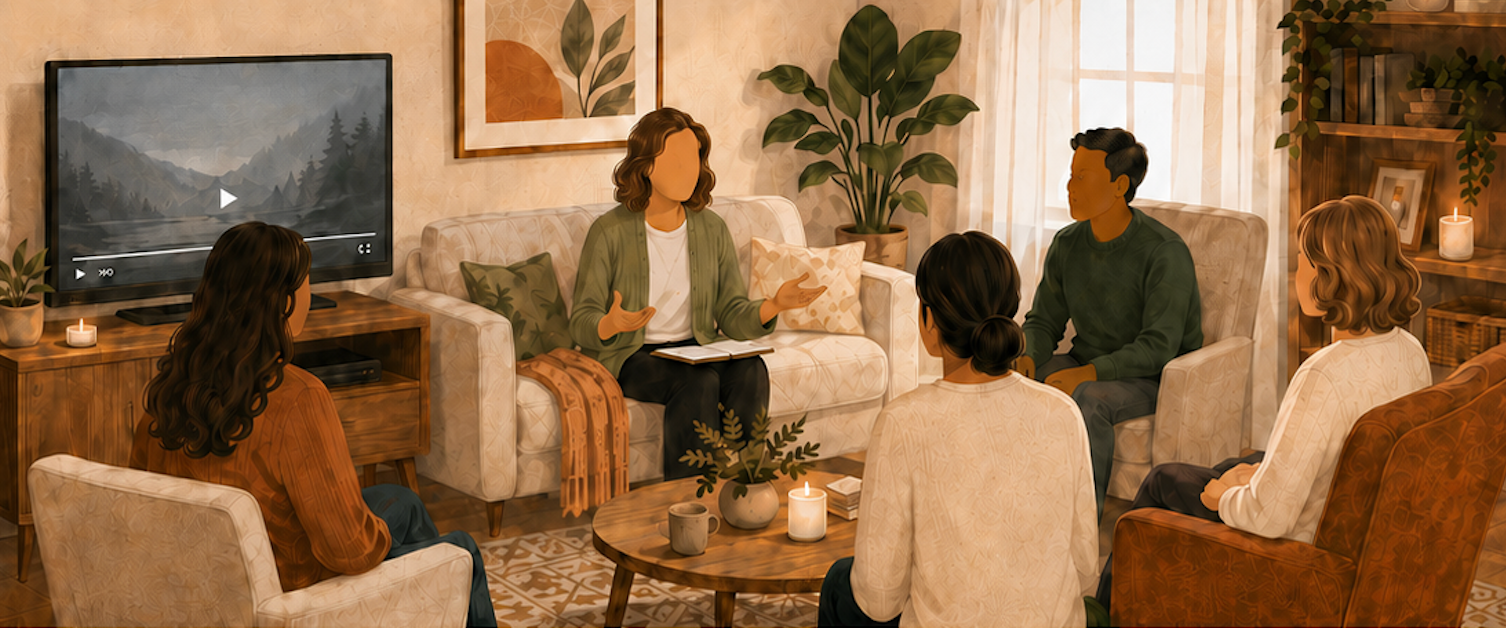
Eight small family-unit screenings will be conducted, each involving 4–8 participants (including the bereaved parents). These participants will be recruited directly through the bereaved parents' networks and can include both immediate family members, extended family members, and chosen family, such as best friends. The number of participants invited to these screenings is designed to make the invitation process feasible for bereaved parents and to ensure a manageable group size for group discussions and data analysis. Each facilitated digital story screening will occur in the home of the bereaved parents, rather than an external location, to create an intimate and informal feel that will encourage discussion. Each session will include:
Viewing three curated digital stories from the SIDS Calgary Digital Storytelling Library
Facilitated dialogue led by DST practitioner Melody Williamson
Clinical support from Danielle Lemky, R.Psych.
These sessions will be audio-recorded and analyzed using reflexive thematic analysis to identify patterns in how participants articulate resonance, difference, recognition, and meaning. Crucially, the screening is conceptualized not as a passive viewing event, but as a relational and interpretive encounter. Participants are invited to respond to the stories through their own narratives, creating a recursive process in which “people respond to stories with stories.” This is particularly relevant in the context of SIDS bereavement, where qualitative research has shown that parents often struggle to initiate conversations about their loss, even within their own families, and may benefit from structured opportunities that invite expression and shared reflection (Cooper et al., 2025; Garstang et al., 2017). This aligns with narrative inquiry traditions that position storytelling as both a mode of expression and a mode of knowing (Clandinin & Connelly, 2000).
Phase 2: Follow-Up Qualitative Interviews
Within three months, participants will engage in follow-up semi-structured interviews exploring the longer-term impact of the screening experience. These interviews will be analyzed using a philosophical hermeneutic approach (Moules et al., 2026), focusing on how participants integrate the experience into their evolving understanding of grief, family, and connection. This approach attends to temporality, recognizing that meaning is not fixed at the moment of encounter, but unfolds over time. This longitudinal perspective is particularly important given evidence that grief following sudden infant death often remains intense and psychologically significant months or even years after the loss (Goldstein et al., 2018; Vance et al., 1995), and that potential changes in family relationships and supports take time to be realized.
Significance and Contribution
This project contributes to the academic understanding of SIDS and DST in three intersecting domains. First, within digital storytelling research, it extends the field beyond creation to reception, offering one of the first systematic examinations of story-based interventions centered on facilitated viewing and dialogue. Second, within the Health Humanities, it operationalizes key theoretical insights about narrative, interpretation, and relational knowledge, demonstrating how these concepts can be enacted within empirical research and applied settings. Third, within bereavement and family health research, it introduces a novel, low-cost, and scalable intervention that has the potential to support emotional processing, communication, and connection among families navigating profound loss. This is particularly significant given longstanding evidence that bereaved parents often experience gaps in psychosocial support and require interventions that move beyond information provision toward relational and meaning-centered care (Smith et al., 2020; Vig et al., 2021).
At a conceptual level, the study advances an understanding of storytelling not as a representational act, but as an ontological and relational process. Stories do not simply describe experience; they actively contribute to how experience is understood and lived. When encountered within carefully facilitated environments, they may open new possibilities for connection, recognition, and meaning.
Anticipated Outcomes
This project will generate:
Eight digital story screening experiences
One reflexive thematic analysis manuscript analyzing screening conversations
One interpretive manuscript analyzing longitudinal impact of digital story screenings
Practice-based recommendations for SIDS Calgary and their digital story library
Beyond these outputs, the project aims to articulate a new model of story-based therapeutic engagement that can be adapted across bereavement and health contexts.

Funded by
Project Partners